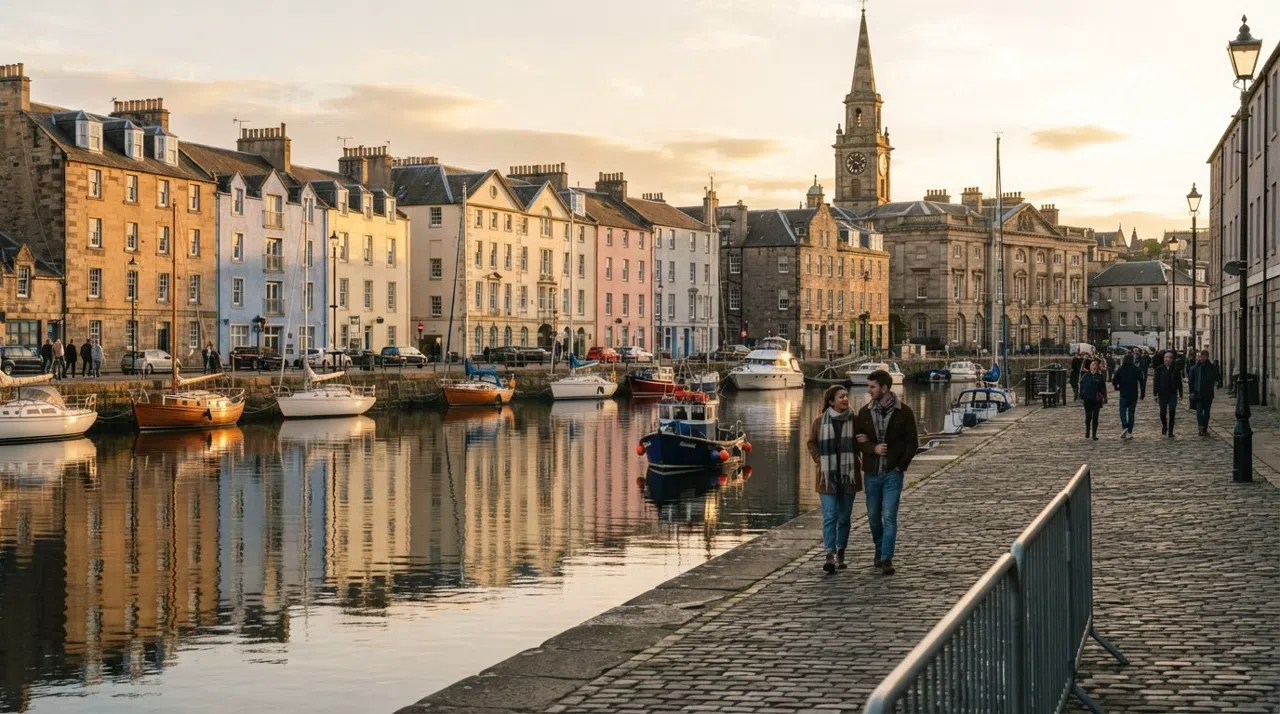

Two miles down the hill from Princes Street, Leith begins with the smell of salt, old stone and frying butter. On The Shore, the quays still curve the way ships once moored, and the place feels like a city that has simply refused to stop working on itself. A nine-storey whisky distillery throws its shadow over the waterfront. A Victorian bar has been pouring pints since 1896. Three Michelin stars sit within a short walk of one another, which is either a miracle of urban planning or proof that the port has developed dangerously good taste.
Leith has spent centuries as Edinburgh’s dock, then decades being treated like a place the rest of the city could forget about if it tried hard enough. That is over now, though the neighbourhood has not gone shiny or polite about it. The warehouses that once stored wine, wool and spice now hold restaurants, roasteries and flats. The streets still feel lived in, not curated. A shift-worker’s caff can sit three doors from a tasting-menu counter. A bagel window can share a railway arch with a gig venue. Everyone still seems to drink in the same freehouses, which is as it should be.
What Leith is known for
Leith is Edinburgh’s culinary engine room, and the neighbourhood knows it. This is where the city comes to eat seriously without losing its sleeves-rolled-up edge, where a lunch can be followed by a whisky crawl and nobody raises an eyebrow. The old port story is never far away either. The street names still carry the grammar of trade — Whisky Quay, The Shore, Constitution Street, Bernard Street — like the map itself remembers what was once unloaded here.
The headline names are famous for a reason. The Kitchin, Tom Kitchin’s flagship on Commercial Quay, has held a Michelin star since 2007 and still leans into a strict nature-to-plate ethos, changing with the season and the catch. Restaurant Martin Wishart on The Shore has held Edinburgh’s longest-standing Michelin star continuously since 2001, with classical French technique applied to Scottish produce. Heron, a bright corner room overlooking the Water of Leith, took its star in 2023 and cooks modern Scottish with the sort of confidence that makes a menu look deceptively calm.
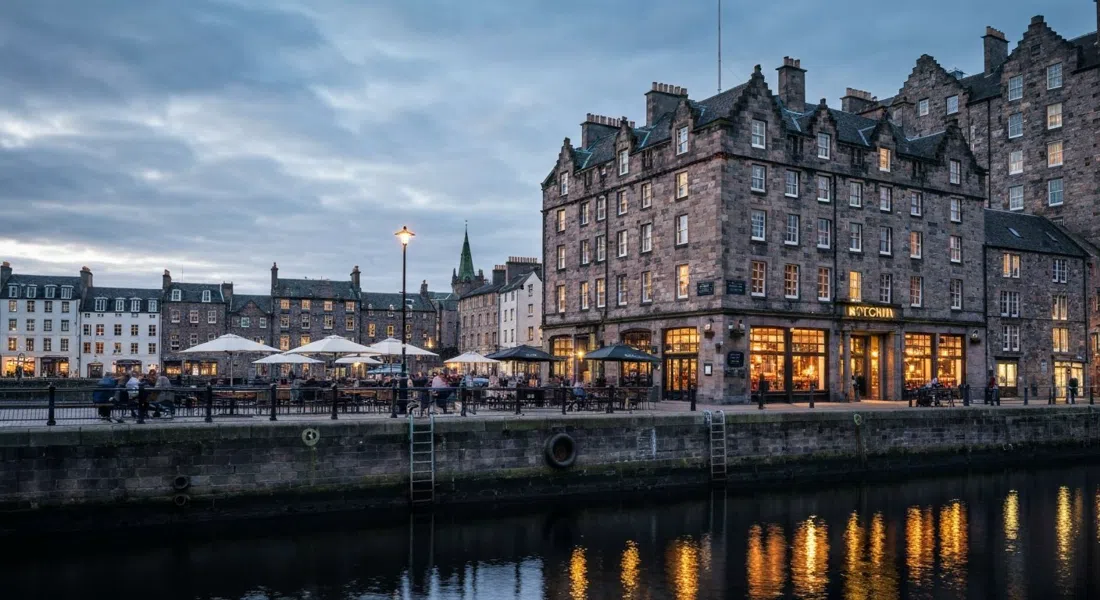
What makes Leith more than a neat cluster of expensive meals is the way those stars sit inside a neighbourhood that still feels unbuttoned. Time Out put Leith 16th on its list of the world’s coolest neighbourhoods, and for once the label did not kill the thing it described. The place still has grit under the fingernails. It still belongs to locals who remember Leith as its own burgh until 1920 and vote as if that distinction remains a live issue. The result is a district with a chip on its shoulder and a very good wine list.
Where to eat & drink
Start at the top, because Leith is one of the few parts of Edinburgh where “the top” is not just a metaphor for prices. The Kitchin is the flagship, and it behaves like one: precise, seasonal, and fully aware that people have crossed the city for it. The tasting menus are around £100, with a set lunch that is, by the standards of the neighbourhood, a comparative bargain. It is the sort of place that reminds you that Scottish produce can wear tailoring.
A short waterfront stroll away, Restaurant Martin Wishart remains one of the city’s anchor restaurants. Its set lunch near £40 is one of Edinburgh’s better fine-dining values, which is not a phrase one gets to say every day without feeling faintly smug. Then there is Heron, where Tomás Gormley and Sam Yorke have made a bright, contemporary room over the Water of Leith. The cooking is modern Scottish — Shetland mackerel, Fife berries — and the room feels like a confident answer to the question of what a neighbourhood restaurant can be when it knows exactly where it is.
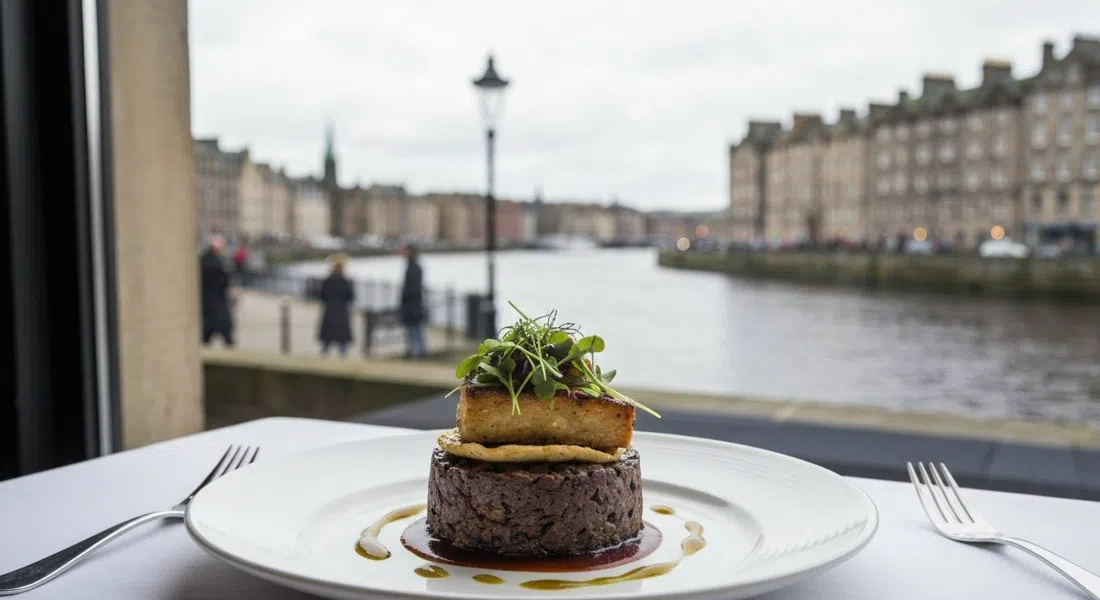
Leith’s newer wave has arrived with less ceremony and, in some cases, more appetite. Barry Fish at 62 The Shore opened in spring 2025 and was in the Michelin Guide within eight months, which tells you something about the speed at which a good seafood room can become part of local habit. It is unpretentious, apple-green, and already the sort of place locals fight for tables at. Then came Brown’s of Leith, which turned a former engineering works on The Shore into a food-and-drink hall with a proper sense of mischief. Inside are Haze, an all-day wine bar from the Timberyard and Montrose team; Shuck, a refined seafood bar from Portobello’s ShrimpWreck; Civerinos, Edinburgh-born and NYC-style in its pizza; and Woven, a whisky-blending bar. That is a lot of ambition for one former works, but Leith has always liked a conversion.
For seafood with a longer memory, Fishers occupies a 17th-century watchtower on The Shore, while The Ship on the Shore has served fish since the 1800s and still does the waterfront thing with Scottish fish and champagne. There is comfort in that continuity. Not everything in Leith has to be new to feel alive.
The drink side of the neighbourhood is just as layered. Teuchters Landing sits right on the water in the former waiting room for the Leith-to-Aberdeen steamboat ferry, with 24 taps, well over 250 whiskies, a beer garden, a bothy and a floating pontoon that fills the moment the sun appears. It is the kind of place that makes a sunny afternoon feel like an event. Nobles on Constitution Street has poured since 1896, all stained glass and nautical carving, and does brunch, late cocktails and live music without making a fuss about any of it. Roseleaf serves cocktails in teacups and does a proper weekend brunch, which is exactly the sort of eccentricity a port neighbourhood should be allowed to keep. The Nauticus on Duke Street leans into Leith’s spice-trade past with a nautical drinks list and Harris Tweed stools, which sounds like a theme until you sit down and realise it is simply the bar behaving as if history should be worn rather than framed.
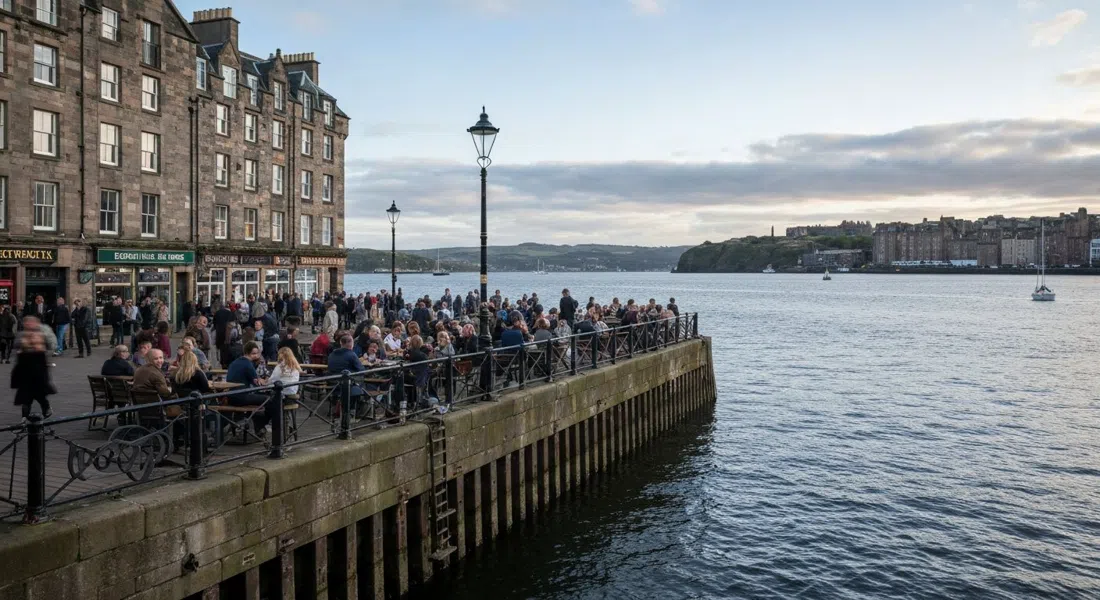
For whisky, the pilgrimage is obvious. The Mother Superior at 96-98 Leith Walk has roughly 800 bottles, a menu of Louisiana soul food and a basement room that hosts jazz, funk and busker nights. It is a whisky bar with a proper pulse, not a museum with stools. Port of Leith Distillery bar takes the view to its logical conclusion: ride the lift to the eighth floor for cocktails and new-wave whisky over the Firth of Forth. It is hard not to feel, up there, that the old port has learned to look down on itself with a certain amount of style.
Things to do
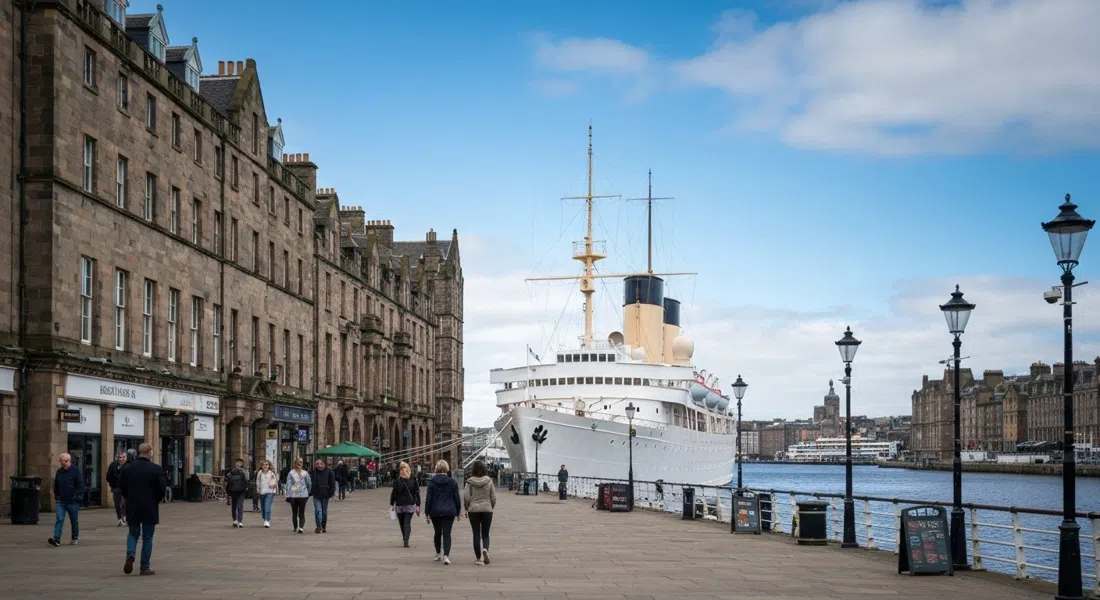
The obvious sight is the Royal Yacht Britannia, berthed permanently at Ocean Terminal. Queen Elizabeth II’s floating home for more than 40 years now sits there with five decks open to self-guided wandering, audio tour in hand, and tea and cake available in the Royal Deck Tea Room if you want your constitutional monarchy with a scone. It is one of those Edinburgh attractions that sounds formal until you are aboard and realise how much domestic detail survives in the ship’s bones.
Just nearby, the Port of Leith Distillery makes a different kind of statement. It is Scotland’s first vertical distillery and, at nine storeys, the tallest whisky distillery in the world. The flagship tour runs about 90 minutes, moving you up through production, letting you fill your own miniature and finishing with a tasting. There is a shorter Distillery Dash if your schedule is more appetite than patience, though in Leith time is usually better spent slowly.
For a gentler hour, follow the Water of Leith Walkway. It threads through the neighbourhood as a green, gull-lined path, running upstream toward Stockbridge and Dean Village or downstream toward the Firth. It is the sort of walk that reminds you Edinburgh is not just a set of monuments but a city with a river quietly doing its own work under the radar. Along the way, the old bonded warehouses and moored boats on The Shore give the waterfront its particular rhythm: active, but not overperformed.
Culture in Leith tends to arrive with a bit of weather on it. Leith Theatre hosts concerts and festival gigs in a grand 1930s hall, and Trinity House on Kirkgate is a small maritime museum full of the port’s seafaring past. If you are here at the weekend, the rotating markets add another layer: food stalls, makers, the occasional seasonal crowd. But the free highlight is always the same — a walk along The Shore itself, with the old quays on one side and the water on the other, feeling like the neighbourhood is still deciding what it wants to be when it grows up.
Shopping & markets
Leith shopping splits neatly between practical and pleasing, which is a very Edinburgh way of saying there is a mall if you need one and better things if you keep walking. Ocean Terminal, next to Britannia, covers the high-street brands, a cinema and chain shops under one roof. Handy in the rain, certainly. Not the reason to come.
The character is in the streets. Constitution Street, Bernard Street and the lanes off The Shore hide independent delis, specialty-coffee roasters like Williams & Johnson, homeware shops and record stores. Leith Walk, meanwhile, runs down from the city like a long, changing argument between grocers, bakeries and secondhand finds, reflecting the neighbourhood’s mix of communities. It is a street that still feels useful, which is rarer than it should be in city-centre Edinburgh.
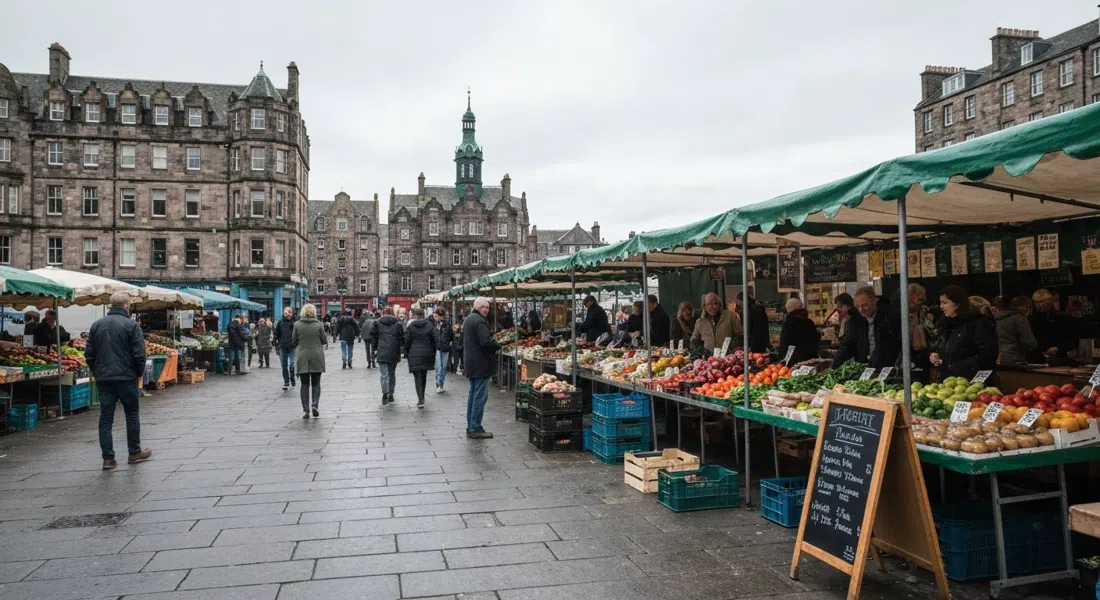
Markets are part of the appeal too. The long-running Leith Market has traded produce, street food and makers’ stalls by the water, and arts spaces like Leith Arches and other former-industrial venues run pop-up and vintage events, especially in summer and during the festival season. The schedule shifts month to month, so it pays to check what is on when you are here. For edible souvenirs, the distillery shop bottles are the obvious purchase, while the delis along Constitution Street will sort you out with Scottish cheese, smoked fish and oatcakes to take home.
Where to stay in Leith
Leith suits travellers who care more about food, drink and a real neighbourhood feel than about being able to step out and see the castle immediately. The prettiest pocket is The Shore, where waterfront apartments and boutique rooms sit right among the Michelin restaurants and old quays. It is lovely at golden hour, and livelier at night than some would like, which is the price of atmosphere. Around Ocean Terminal and Newhaven you get newer hotels and serviced apartments, quieter and better value, with the tram stop on the doorstep for a quick run into town. Up on Leith Walk, you are closer to the city and the tram line, in a more everyday urban stretch with bars and cafes all around you.
The price feel is generally friendlier than the Old Town or New Town for what you get, though August festival dates and Hogmanay push everything up sharply across the whole city, so book well ahead if you are coming then. Light sleepers should ask for rooms set back from The Shore and Leith Walk, both of which stay busy late.
Getting around
The tram changed Leith. The Newhaven line runs the length of Leith Walk and down to the waterfront, with stops at Foot of the Walk, The Shore and Ocean Terminal among others. Trams come every seven minutes and reach the New Town and city centre in roughly 15 to 20 minutes, with the same line continuing all the way to Edinburgh Airport, no changes needed. A single city-zone tram fare is around £2.40, and since May 2025 you can tap on and off with contactless. Buses, notably the frequent Lothian services down Leith Walk and Constitution Street, cover the same ground for a flat fare, and taxis are plentiful.
Once you are here, Leith is flat and eminently walkable. The Shore, Constitution Street, the distillery and Britannia sit within a compact, level grid, which is a mercy after the Old Town’s theatrics. The Water of Leith Walkway doubles as a traffic-free route toward Stockbridge and the West End if you fancy walking back into town, though you should allow 40 to 50 minutes to Stockbridge. Cycling is easy on the flat, and the airport tram makes Leith one of the simpler Edinburgh bases for anyone flying in and out.
Leith is not a neighbourhood that asks to be admired from a distance. It works best at street level, with damp stone underfoot, a pint in hand, and the sense that the city’s best stories are happening a little further down the hill than the guidebooks used to bother with.